
The Business Operating System: What It Is and Why You Build Your Own Now
The manual is open. Here is the thing it teaches, and why nobody has taught it this way before.

In April I published the entire automation that schedules 35 Substack Notes a week. Every node. Every header. The webhook, the endpoint, the whole thing. Free.
The response taught me more than the build did.
Nobody asked about the webhook. Not one person. Every question that came back was some version of the same two: “But what do you write?” and “How does it know your voice?”
I gave away the plumbing and everyone asked about the water.
That is when the shape of this became clear to me. The scarce thing was never the automation. Anyone can copy an automation. The scarce thing is the layer underneath it: the decisions about what gets made, for whom, in what voice, from what source, checked against what standard. That layer has a name.
It is a business operating system. And I think it is the single most valuable thing an operator can build right now.
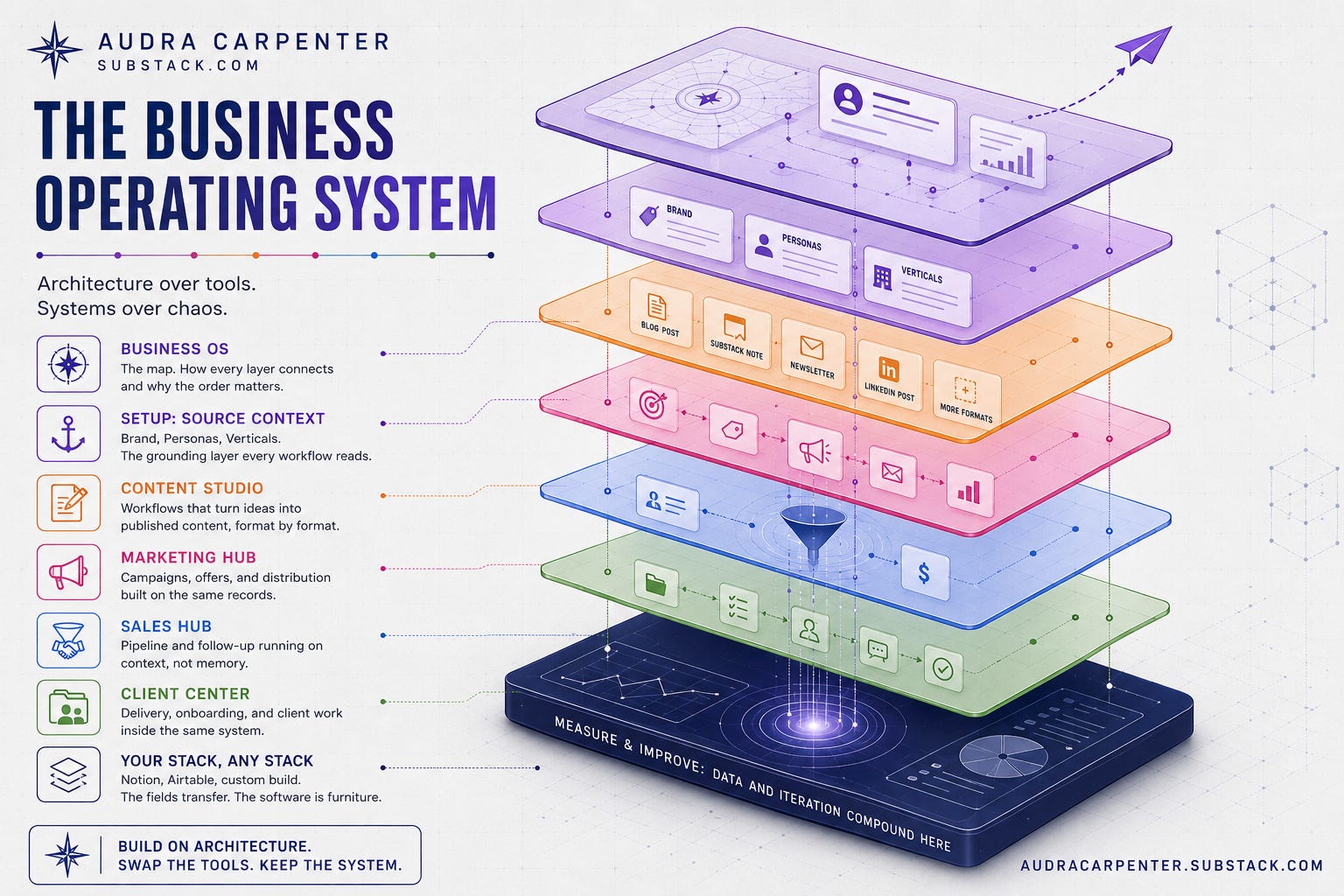
What a business operating system actually is
Strip the jargon and it is this: the processes you currently run out of your head, turned into repeatable workflows, that you then manage instead of perform.
Notice the three moves in that sentence, because each one is a different kind of work.
First, the process has to come out of your head. Right now, the way work gets done in your business lives in tribal knowledge. Ask how the newsletter gets produced and the answer is a person’s name. Ask what makes a post on-brand and the answer is “I know it when I see it.” I have watched this in client businesses for sixteen years. The workflow was never documented because it never had to be. A human carried it, and humans fill gaps automatically.
AI does not fill gaps. AI exposes them. Hand a vague process to a machine and you get the average of everything it has ever seen, which is to say, you get generic. Your output problem is not a model problem. It is a specification problem. The decision logic never got written down, so the system has nothing to run on.
Second, the process becomes a workflow. Not a prompt you retype every morning. A structure: the brand context, the audience definition, the source material, the format rules, the quality bar, connected in an order that produces the same class of result every time you run it.
Third, and this is the part that changes your job, you stop performing the workflow and start managing it. You review outputs instead of producing them. You refine the system instead of repeating the task. Your time moves up a level and stays there.
That is the whole thing. Processes out of heads, into workflows, under management.
Why you build it now, and why you build it on nothing
The models are commoditizing. Whatever is the best model this quarter will not be the best model next quarter, and the quarter after that the pricing will change, and the quarter after that something you have never heard of will top a benchmark.
If your operation is built ON a model, every one of those shifts is a rebuild.
If your operation is built on architecture, every one of those shifts is a dropdown.
I mean that literally. In the system I run my publications with, the model is a select menu on a form. Brand context, personas, source material, style guides, prompts, none of it moves when I change the model. The intelligence layer is swappable because the architecture layer is mine.
That is the difference between renting and owning, and it is the reason this manual is tool agnostic by design. I am not teaching you my software. I am teaching you the architecture, and the architecture transfers to whatever stack you already have. Airtable, Notion, a Claude project, a custom build. The fields are the asset. The software is furniture.
So why doesn’t everyone have one
Because five real obstacles stand in the way, and I have watched every one of them stop capable operators cold.
No time to build while the business is running. You cannot take the machine offline to redesign the machine. The work that pays for the redesign is the work the redesign keeps interrupting. So the system project waits for a quiet month that never comes, and every month it waits, the manual coordination it would have eliminated gets paid again.
Nobody taught you how. The internet is full of automation tutorials and empty of architecture. You can find a thousand videos on connecting tool A to tool B. You cannot find the decision logic that determines whether the connection produces anything worth having. The thinking is the hard part, and the thinking is exactly what nobody ships.
The workflow lives in tribal knowledge. It is in your head, your assistant’s head, that one contractor’s head. Every handoff between heads is a coordination tax you pay in meetings, Slack threads, and rework. The knowledge walks out the door every time someone does.
You cannot reverse-engineer what you have never seen. This one is underrated. If you have never stood inside a working business operating system, you are being asked to build a house from a description of houses. Every framework you have bought came as slides. Slides are a description. You need a building.
Your team will not build it for you. Your people are maxed out doing the jobs they were hired for. Asking an employee to systematize the founder’s decision logic on top of their actual role is asking them to volunteer for a second job that mostly benefits the org chart. They will not, and they should not have to. The architecture is the founder’s to build, once, so the system can carry it instead of staff.
Every obstacle on that list is a design requirement I took seriously. Which brings me to the announcement.
The manual is open
Today I am opening the Content Hub OS Build Manual at build.contenthubos.com.
It is a membership that teaches you to build your own internal business operating system, in your own stack, with my live system as the working example. Not a course you binge and forget. A reference building you walk through while you construct yours.
Here is how it answers the list:
No time? The manual ships in staged drops, one layer at a time, sized to be built in the gaps of a running business. You are never handed a weekend-destroying architecture project.
Don’t know how? Every drop documents the thinking first, the decision logic behind each record and workflow, then the build path. The part nobody ships is the product here.
Tribal knowledge? The entire method is extraction: pulling your processes out of heads and into records a system can run on. That is not a feature of the manual. That is the manual.
Never seen the end result? My production system is the standing proof. It runs two publications, a daily podcast, and every piece of content I ship, every day, at real volume. You are not imagining an outcome from slides. You are looking at one, and then building yours.
Team maxed out? You build the architecture once. The system carries it from there. Nobody volunteers for a second job.
What is open on day one: the full Business OS overview, and the Setup hub, the source context layer that everything else runs on. The first Content Studio playbook follows right behind it, and I will tell you exactly what is in it below, along with the build order, the three roles you will operate in, and where to start this week.
The three roles
Every business operating system, whatever it is built in, gets operated through three roles. You will move between them constantly, and knowing which hat you are wearing is half the discipline.
The Architect designs the logic. What records exist, what fields they carry, what order the workflow runs in, what the quality bar is. Architect work happens rarely and matters most.
The Operator manages outcomes. Reviews what the system produced, approves, redlines, feeds decisions back into the structure. This is where your judgment lives, and it is the role you will spend most of your time in once the system runs.
The Automator connects the tools that execute. Webhooks, schedulers, API calls, the plumbing. Important, replaceable, and last. The April scheduler article I published was pure Automator work, which is exactly why it was safe to give away.
The order matters: Architect, then Operator, then Automator. Every failed automation project I have ever audited ran the order backwards. They wired tools together before the logic existed, and then wondered why the machine produced chaos at speed.
How the manual is organized
The site walks the same order the build does:
Business OS is the map. The full picture of what you are constructing and why the layers stack the way they do.
Setup is the grounding layer, and it is open now. Three required records before any content workflow runs: Brand, Personas, Verticals. Who the business is, who the reader is, what world they operate in. Without all three, output is generic, and generic is the tax you are currently paying on every AI interaction you have.
Content Studio is where workflows produce. Blog posts, social, email, newsletter, podcast, YouTube, Substack articles, Substack Notes. Each module opens as a playbook drop: the thinking, the build, the run.
Marketing Hub, Sales Hub, Client Center follow. Same architecture, different domains. Content is the proving ground because it is the highest-volume, fastest-feedback workflow in your business, which makes it the best place to learn the pattern.
Guides, Playbooks, Templates, Build Paths hold the artifacts: the records, the prompts, the field structures you copy and adapt.
Two more things you get as a member. Every drop has its own discussion thread in the comments, so ask your questions there, where the answer helps the next builder too. And once a month we build live on Zoom: I construct something real in my production system, narrate the decisions, then open the floor for questions and member builds. Every session is recorded and filed in the library.
What drops first, and why
The first Content Studio playbook is the Substack Note, end to end.
If that seems small, it is small on purpose. The Note is the shortest possible proof loop for the entire architecture. You will build the source context, run a generation workflow against it, and see the difference between grounded and generic in an output short enough to read in ten seconds. Then you will schedule it with the automation I published in April, which means the loop you complete is the actual loop: idea, decision logic, generation, review, published, without you carrying any handoff in between.
Same prompt, run twice, is the demonstration that sells the whole method. Once with no brand, no persona, no style guide. Once fully loaded. You will not need me to explain the difference. You will see it.
And you are reading this on Substack, which means the first workflow you build is one you can put into production the same week, in front of the same audience, on the same platform. No hypotheticals.
Where to start this week
Three moves, none of which require the manual, all of which the manual will deepen:
One. Pick a single recurring content task you performed this week. Write down, in plain language, every decision you made while doing it. What you chose to say, who you pictured reading it, what you refused to include, what made it done. That document is ugly and it is the first real record of your operating system. The gap between what you wrote and what you actually decided is the gap the Setup layer closes.
Two. Look at where that knowledge currently lives. If the honest answer is a person’s name, you have found your coordination tax. Write down what it costs you per week in handoffs, re-explaining, and rework. That number is the budget for this build.
Three. Join the manual and start with Setup. Brand first. The starter record structure is waiting in the hub, and next week’s drop walks the full source context layer, field by field, with the reasoning behind every one.
The models will keep changing. The tools will keep changing. The architecture you build this quarter is the thing that does not.
Build the part you get to keep.
~ Audra ✌️
P.S. The system I will be showing you throughout the manual is not a demo environment. It is the live application that produces everything you have read from me this year, including this article’s Notes, this week’s podcast episodes, and the scheduler that will distribute all of it while I am doing something else. The manual does not teach a theory. It documents a machine that is currently running. build.contenthubos.com