
The Model Was Right. The Infrastructure Wasn't.
Why the GaryVee content model finally works for businesses without a large team

In 2019 Gary Vaynerchuk published his content strategy framework. One pillar piece of content, a keynote, a vlog, a podcast, repurposed by his team into 30 or more assets distributed across every platform. One keynote. 35 million views.
It was the right model. It still is.
The problem was who could actually run it. It required production teams, editors, social media managers, and coordinators. Large brands. Well funded startups. Creators who had already built enough revenue to hire the infrastructure the model required.
Small businesses watched the framework and tried to copy it anyway.
Two people. A Canva account. A shared Google Drive full of half finished drafts. They’d have a good week, get three posts out, maybe a newsletter, feel like they were finally ahead of it. Then a client emergency would hit or someone would get sick and the whole thing would collapse. Three weeks of silence. Start over.
They concluded they had a content problem.
They didn’t. They had an access problem.
The model required infrastructure. The infrastructure required headcount. The headcount required revenue the content was supposed to help generate in the first place. It was a loop most small businesses couldn’t enter.
That loop just broke open.
Not because AI writes better content. It doesn’t, not without significant human direction and judgment. But because AI has fundamentally shifted the ratio of human effort required to run a content operation at scale.
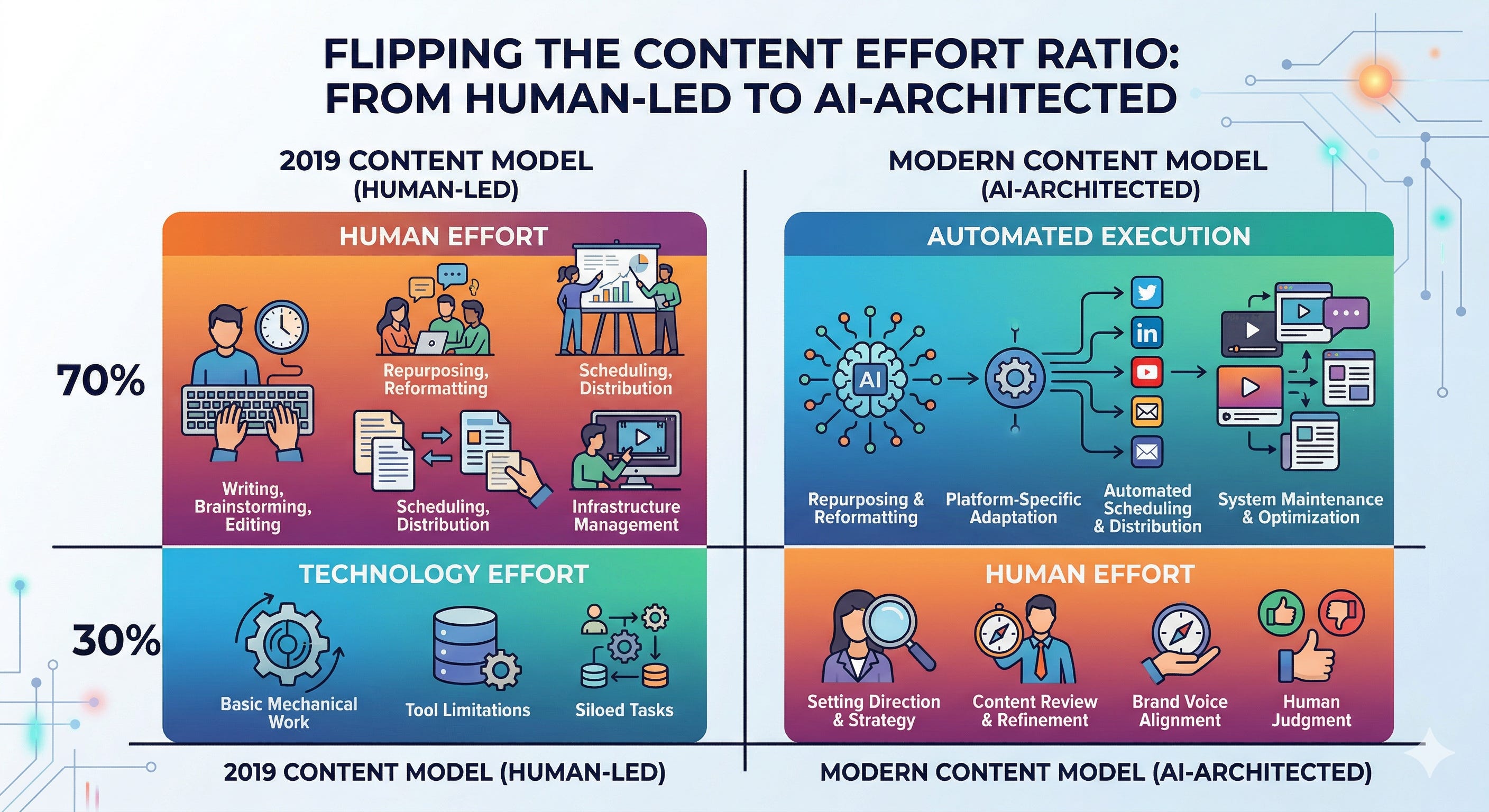
For most of the last fifteen years the split looked something like 70/30. Seventy percent human effort holding the system together. Thirty percent technology doing the mechanical work. The humans were still the system. Moving content between tools. Reformatting for each platform. Tracking what went where. Deciding what got repurposed and when.
That ratio is flipping.
Not to zero humans. Anyone telling you to remove humans from your content operation entirely is selling you a shortcut that will cost you your brand voice inside six months.
The point is that a well architected content system today can run closer to 30 percent human effort and 70 percent automated execution. The human sets the direction, reviews the output, makes the judgment calls. The system handles the movement, the reformatting, the scheduling, the repurposing, the distribution.
What that means practically is that the Gary V content machine is now accessible to a business of one.
Not a watered down version of it. The actual model.
One pillar piece enters the system and generates everything downstream. That pillar piece is whatever long form content you’re already creating. A blog post. A podcast episode. A YouTube video. A newsletter. The format doesn’t matter. What matters is that one piece of substantive content becomes the source for everything else.
To be clear about what the system does and doesn’t do. If you record a podcast or film a YouTube video the recording still requires you. The camera, the microphone, showing up. That’s yours. What the system handles is everything that comes after. The transcript becomes the blog. The blog generates the social posts, the email, the newsletter, the images. The post production that used to require a team now runs inside one system without a team.
But you don’t have to start with audio or video. If a blog post or newsletter is your pillar piece you can create it directly inside the system and build the same asset stack from there. The entry point is flexible. The output is the same.
That’s not a writing tool. Writing tools already exist. This is an architecture. The difference between a writing tool and a content architecture is the difference between a hammer and a construction system. One helps you do a task. The other determines how the whole thing gets built.
Small businesses couldn’t run this model before. Not because they lacked the ideas or the strategy. Because they lacked the infrastructure. That changed.
The machine was never broken.
It was just waiting for the infrastructure to catch up.
✌️ Audra
P.S. Content Hub OS is where I'm building it. If you want to see what the infrastructure actually looks like.